The ROI of knowing your audience
Who’s out there?
Where are they?
What do they need?
What do they want?
Who should you really be targeting?
Research-based personas — detailed, data-grounded profiles of your target customers built on qualitative and quantitative research — help you answer those questions and more. Carefully crafted personas help you target and reach the right people where they prefer to consume media and show them exactly what you’ve got to offer.
Reaching the largest possible audience sounds like the right instinct, but volume without relevance rarely converts. Broad, undifferentiated marketing spreads your message across audiences that may have little interest in what you offer, driving up costs while diluting impact. Research-based personas shift the focus from reach to resonance. Instead of casting the widest net, you place smaller, precisely targeted ones — built on real behavioral, psychographic and motivational data — in the channels where your best prospects actually spend their time. The difference shows up where it matters most: in engagement, conversion rates and ROI.
Vendi has created comprehensive research-based personas for numerous clients, including American Association of Nurse Anesthesiology, WinnMed, University of Minnesota Morris, University of Wisconsin-Platteville, Winona State University, Wisconsin Department of Workforce Development and others. In each case, the goal is the same: to ensure that media, marketing and creative decisions are grounded in a real understanding of the people you most need to reach, not assumptions about them.
The finer points of persona development
1. Don’t rely on gut feelings alone
Instinct has its place in creative work, but as a starting point, not a destination. Gut feelings about what people want from your organization tend to lead to generalizations and stereotypes that don’t hold up under scrutiny and can introduce unconscious bias. Research-based personas replace assumption with evidence, incorporating demographic and psychographic details, behavior trends, values, desires, pain points, affiliations and more. The result is a far more precise, actionable understanding of your market segments — one that can directly inform relevant, meaningful messaging and strategies.
2. Build on rigorous research
Personas are only as strong as the research behind them. Qualitative and quantitative methods each play a distinct role: Qualitative research surfaces the language, motivations and stories behind audience behavior, while quantitative research validates patterns and reveals how broadly they apply. Not sure where to start? Vendi’s in-house research capabilities are purpose-built for this work. Vendi researchers craft, perform and report on qualitative and quantitative research that enables you to:
- Gauge your target audiences’ awareness and perceptions of your products and services relative to your key competitors
- Identify factors that influence audience members’ decision-making process
- Reveal your points of differentiation and messaging hot buttons
- Identify how attitudes, perceptions and needs differ by segment
3. Find answers through analysis
Raw data doesn’t speak for itself; it requires experienced analysis to become actionable insight. Vendi’s analysts combine an inquisitive mindset with practical methodologies and advanced statistical techniques to properly segment your audience and surface clear, prioritized recommendations. Two of the most powerful tools in this process:
- K-means cluster analysis groups respondents into distinct audience segments based on shared attitudes and behaviors — essentially finding the natural “tribes” within your data.
- Maximum differentiation (MaxDiff) analysis precisely determines which attributes matter most to your audience, allowing you to rank and prioritize messaging themes with confidence. It also helps sharpen the segments defined through cluster analysis.
Together, these techniques move you from a general sense of your audience to a specific, evidence-based picture of who they are and what they care about.
4. Personify your audience segments — and keep them current
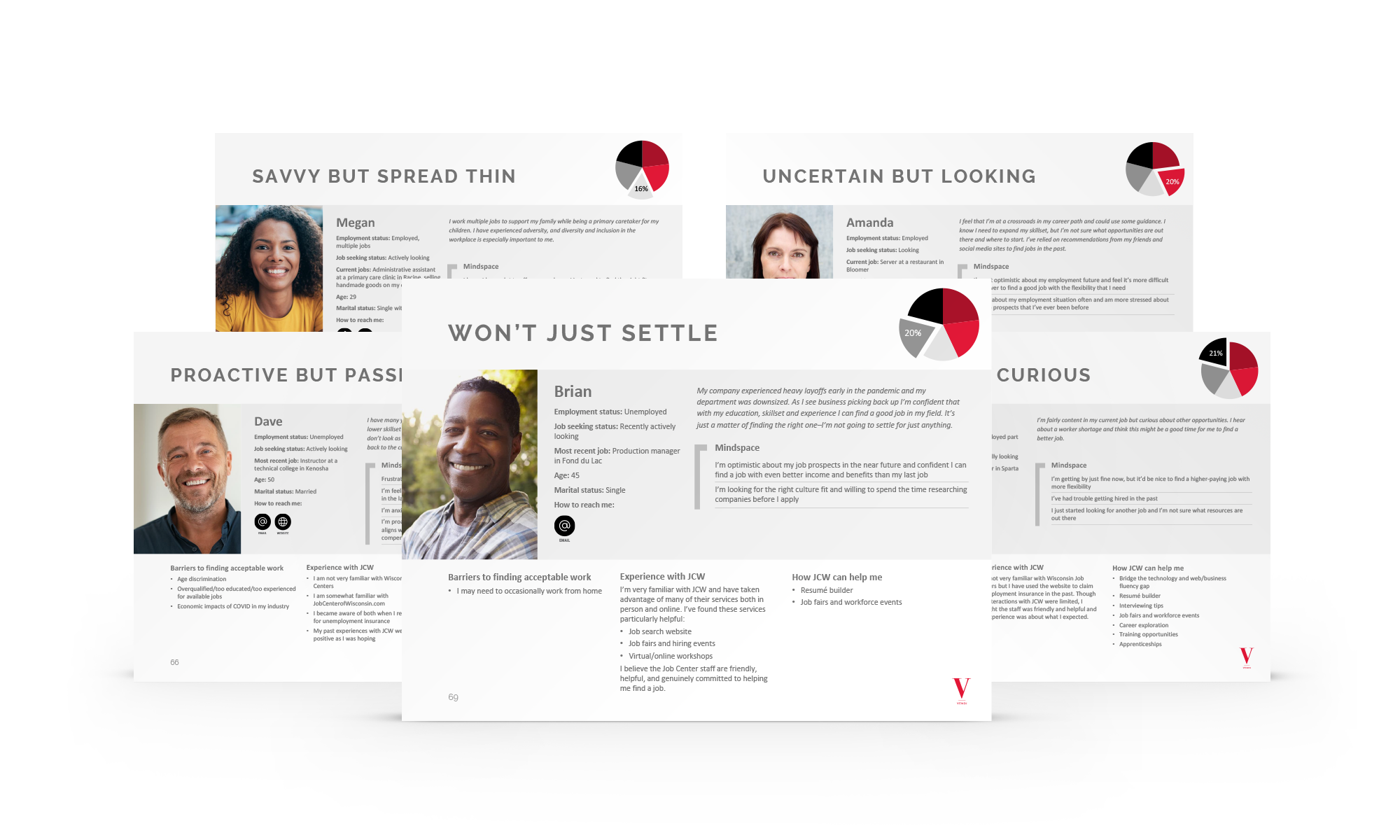
The segments defined through analysis become the foundation for your personas. Depending on the research, each persona typically includes a representative name and photo; demographic details such as age, occupation, education level and family status; mindspace (goals, attitudes, needs and challenges); and key influencers and opportunities to engage. A memorable, descriptive segment name, such as “Idealist,” “Pragmatist,” “Ready for Change,” “Newcomer” or “Trailblazer” can make personas easier to recall and apply across teams.
One important note: Personas aren’t a set-it-and-forget-it tool. Audience attitudes, behaviors and needs shift over time and so should your personas. High-performing marketing teams revisit and update their personas regularly, ensuring their strategies stay grounded in current reality rather than outdated assumptions.
Vendi personas help you sharpen your messaging, strategies and impact
Once you’ve brought your audience segments to life, your understanding of their current and future needs, motivations and goals will only grow. You’ll have the insights you need to consistently speak to and hit the right targets. The team at Vendi is ready to help and has vast experience in creating and using personas to:
- Craft targeted creative content that’s meaningful and motivating for each audience segment, directly addressing why you are their best choice
- Optimize marketing strategy to ensure the right audiences get the right messages at the right time and in the right places
- Develop marketing communications and media plans that most efficiently and effectively intersect with audience segments
- Inform the development of new products and services that may address customer wants, needs or challenges
- Perform keyword research that ensures your content reaches the right people and ranks optimally in search engine results
In today’s information-saturated world, where consumers expect personalization and have little patience for messaging that doesn’t speak directly to them, research-based personas are anything but a luxury. They’re the foundation that makes targeted, efficient marketing possible. And as third-party data becomes less reliable, the value of rigorous, first-party research grows even greater: the organizations that invest in genuinely understanding their audiences will have a lasting competitive advantage over those that don’t.
Since 2004, the experts at Vendi have created and used research-based personas to help clients across numerous market verticals sharpen their focus, strengthen their messaging, and boost their impact and bottom line. Let us show you the ROI of knowing your audience.